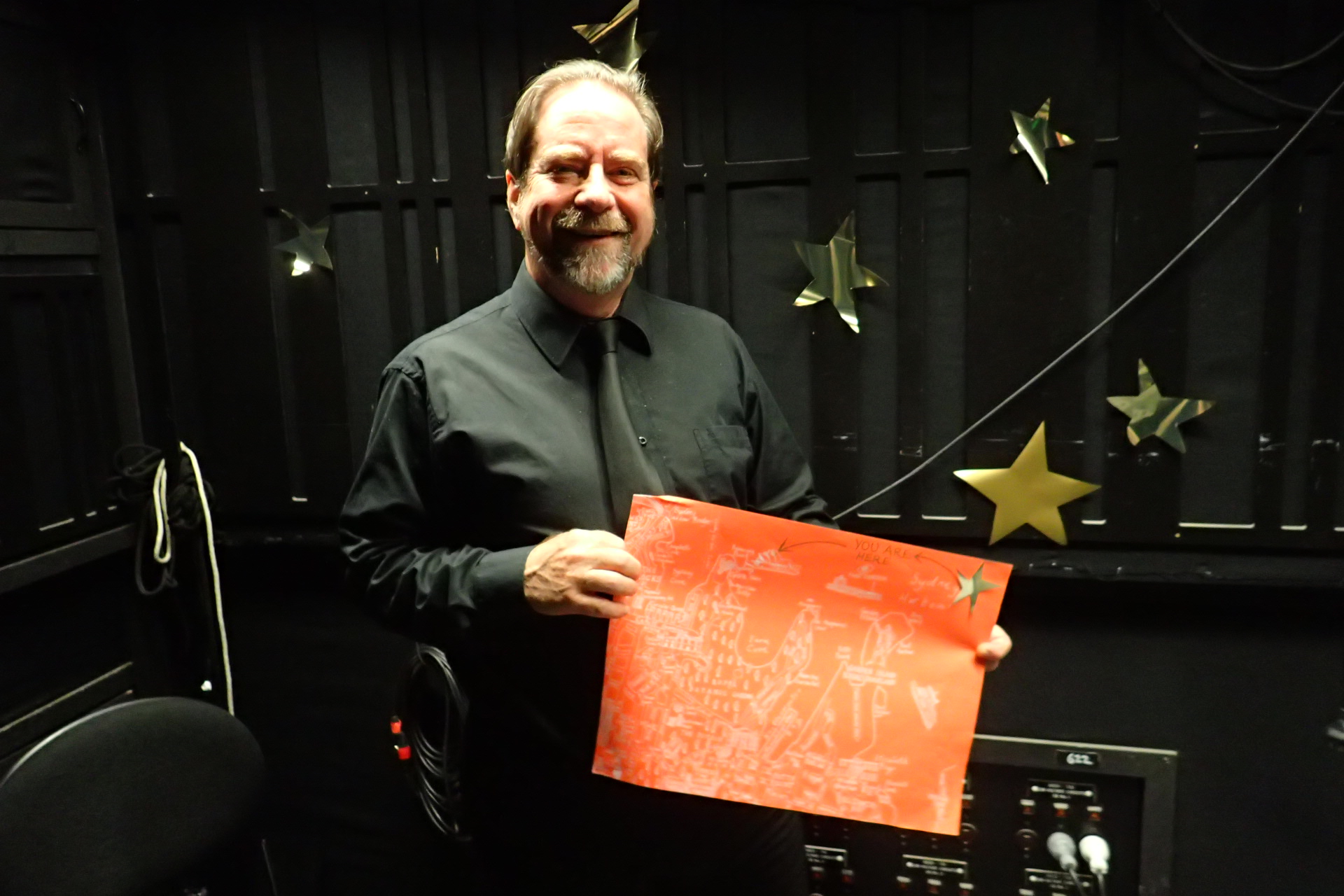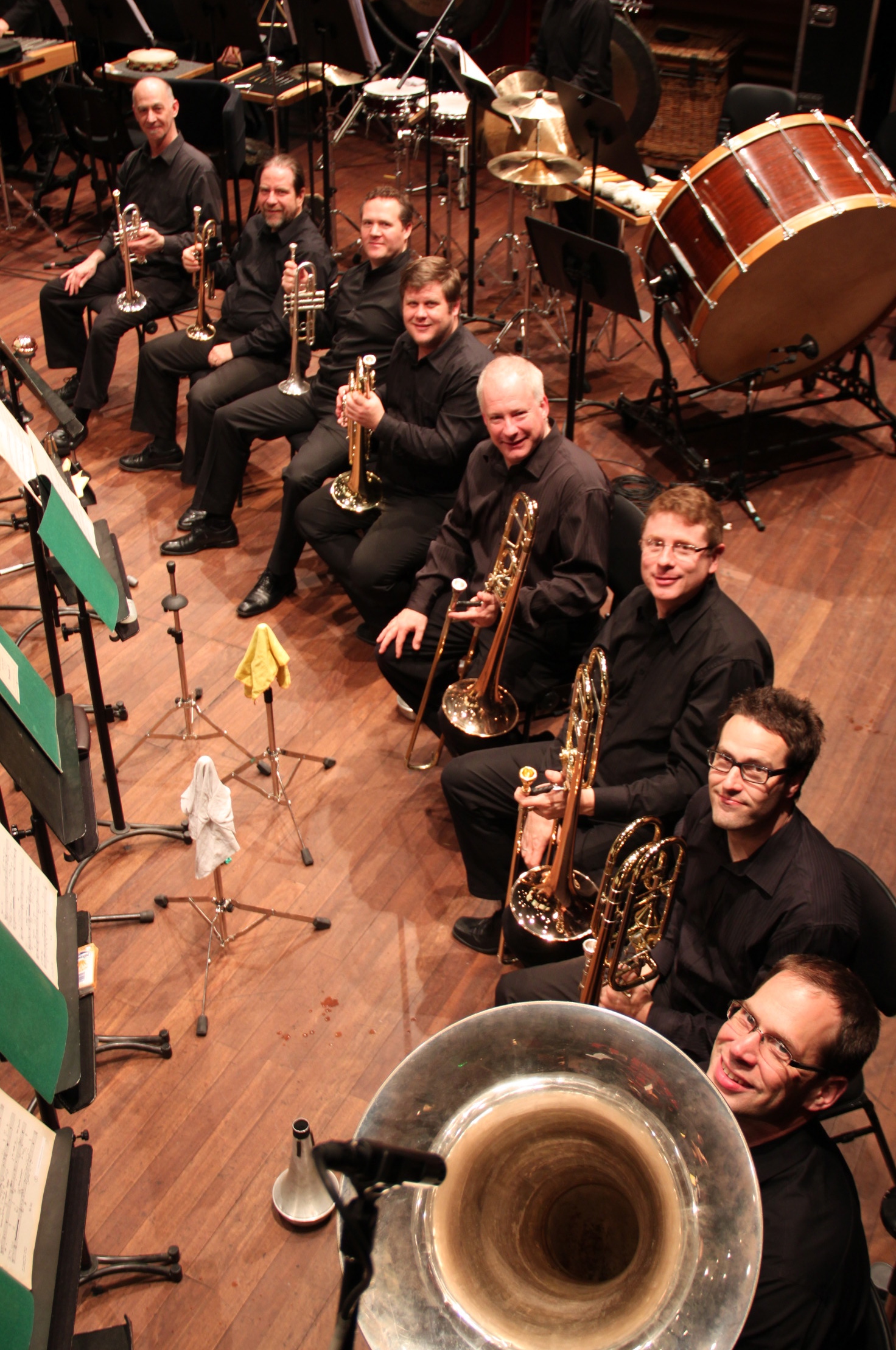
The air was crisp in West Chester, Pennsylvania as trumpeters from near and far flocked to West Chester University’s beautiful new Performing Arts Center. Student volunteers from the newly-formed West Chester University chapter of the International Trumpet Guild welcomed everyone for what would prove to an information-filled, awe-inspiring, and artistically fulfilling day. The event, hosted by Dr. Jean-Christophe Dobrzelewski, was made possible by a grant from ITG and Felix Vayser from New York Trumpet Company.
Luis Engelke: Solo and Ensemble Preparation
Luis Engelke, Professor of Trumpet at Towson (Maryland) University, kicked off the day with a master class combining important concepts in brass performance and modern technology. After performing Otto Ketting’s Intrada with vigor and a tasteful array of rubato, Engelke expressed his interest in stretching and tension relief exercises. The audience stood and worked on some tried-and-true and some new adaptations of thoracic stretching and breath building. One that was quite challenging involved breathing in for eight counts, holding for one minute, and then exhaling for eight counts, which Engelke said, “develops the ability to sustain long phrases such as the first movement from Telemann’s Concerto in D.“ Additionally, maintaining a smooth air stream during exhalation is critical in this part of breath control.
After the audience was safely seated, Engelke began his discussion on utilizing modern technology for practice on the trumpet. The first tool discussed was familiar to everyone: the metronome. Engelke suggested not merely playing with the metronome during ensemble practice, but instead, starting with it on, turning it off after beginning the piece, and then turning it back on later (before stopping) to compare if the tempo had altered. This way one can see trends or patterns of rushing and address them at the source.
The first West Chester trumpeter to perform played the exposition of the first movement of the Haydn Concerto in E-flat. Though the performance was musical and well prepared, some intonation inconsistencies could be heard. Engelke suggested the use of drone pitches while practicing to become intimately familiar with pitch tendencies. Engelke had the student work on an E-flat major scale with an E-flat drone slowly to hear the pitch relationships. After returning to the Haydn Concerto, a marked improvement in intonation was obvious to all.
The second student performed the Grand Russian Fantasia by Jules Levy. His performance was technically accurate and expressive. Engelke discussed rubato by quoting a past teacher: “If you’re behind and have to catch up, you’re rushing. If you are ahead and slow down, you’re using rubato.”
Engelke addressed two new pieces of software that enhance personal practice. The first, Audacity, allows the player to record and then playback at slow speeds to hear intricate errors in rhythm, attack, and intonation, among other issues. Virtual Studio Technology (VFT) creates artificial reverb. This simulates tuning intervals in a large symphony hall. Both of these software programs use a USB microphone.
Luis Engelke’s master class demonstrated many new, technological aides for practice as well as sound information on stretching and staying loose, with no tension.
James Ackley: Interpreting Our Music
James Ackley, Professor of Trumpet at University of Connecticut, energetically awakened the musical minds of all present. He stressed throughout the class that being well educated and knowledgeable about each piece that we perform is of utmost importance. Ackley reminded us that since “music is generated from the heart but controlled by the mind,” we must prepare ourselves to interpret correctly by looking up information in books, from the definition of an unknown word to the history of a composer. He then brandished three musical reference books that he had in his case.
Ackley said that there are guidelines to follow when preparing a piece, two of which are style traits and sound concept. Both of these issues have been “handed down through time. “Every period, region, and lineage of music has these traits.” We know that Hindemith was German, for example, and that information dictates that his trumpet sonata is played in a heavy, direct fashion. On the contrary, Tomasi would be played in a light, buoyant manner since his music was written in France and is neo-classical with a jazz influence. When encountering lesser-known or obscure composers, musicians need to research their influences and past teachers. David Diamond might not be well known to trumpeters, but upon reading about him, finding out that he studied with Nadia Boulanger and was good friends with Aaron Copland, we begin to grasp his style and vocabulary.
Also, style sets can transfer from piece to piece. Ackley noted similarities between several pieces in our repertoire, and correctly noted that the Hindemith and Kennan sonatas are quite similar. The initial phrase of both are the same length (nine measures) and have a similar structure, beginning with a bold fanfare statement followed by a lyrical, slurred line. Therefore, even though these two composers are not from the same region, we can cross over the sound concept and style traits.
In the end, Ackley stated that the goal is to get through the performance by sticking to the game plan. “Leave emotion on your sleeve -- that’s where it belongs.” Utilizing Ackley’s techniques and thought processes greatly aides in proper preparation and effective performance.
Frank Kaderabek: Fundamentals of Trumpet Playing
When Frank Kaderabek, retired Principal Trumpet of the Philadelphia Orchestra and one of the most respected and successful trumpeters in history, announced that he would like his class to be an “informal conversation,” everyone present knew that they were in for a treat.
Kaderabek started his class by stating that only playing the correct notes during a performance is not good enough; musicians must always say something through the music. “Everyone has something different to say; we shouldn’t lose sight of that.” He demonstrated Beethoven’s Leonore No. 3 in an appropriately bravura manner and followed it by suggesting that if you play with no vibrato “you might as well play an automobile horn.” After the audience subsided from their laughter, Kaderabek approached the topic of the class, fundamentals of trumpet performance.
Tonguing proves to be the most difficult aspect of trumpet performance to master and especially to maintain. The plethora of options must be addressed in practice so in performance we are flexible and versatile (to please the conductor). Kaderabek recommended that trumpeters move away from the “du du du” in favor of a more crisp and energetic articulation. When addressing multiple tonguing, he said that it should sound like a fast single tongue.
Practicing must be done intelligently to be as productive as possible. When Kaderabek was in high school, he practiced for twelve hours a day for three months, thinking that the more time on the horn would make him better. After realizing that he could not smile any longer due to muscle fatigue, let alone play the trumpet, he decided that practicing fewer hours per day in a more intelligent way worked much better. The brain, he said, only functions for twenty minutes at a time at optimum level, so trumpeters must take a break during practice sessions not only to rest the lip but also to rest the mind. He reminded us that breathing naturally with no tension combats fatigue. Also, Kaderabek found it useful to not think of a warm-up, but to just start practicing, switching his routine from day to day and using thought always. This keeps things fresh.
To end his masterclass, Mr. Kaderabek performed Facalita by Hartmann with effortless control, virtuosity, and a strong command of all registers of the trumpet. Listening to stories and anecdotes from this great musician proved a wonderful experience to all who attended.
Craig Morris: The Performer’s Mind
Professor of Trumpet at the University of Miami, Craig Morris enlightened and inspired the audience with cutting edge techniques to harness and control one’s mind while playing, from practice sessions to auditions for major symphony orchestras.
After masterfully performing one of J.S. Bach’s sarabandes originally written for recorder, Morris stated that “musical expression is key.” Everyone should play to make music, but the amount of musical expression one can produce depends on the amount of technique or skills one has developed. Technique acts as the conduit of musical expression; the larger the conduit, the more tools one has to create musical expression. He defined the greatest performers in the world as having high skill level combined with a great musical imagination.
Morris then bridged into the topic of the master class: the performer’s mind. Through a systematic and well-organized method, he described the difference between the convoluted mind (where focus is not in the present) and the focused mind (focus is only in the present and immediate future) stating that the focused mind allows for great performances.
Morris explained: the process to attain the focused mind includes stages in which we must mentally place ourselves. The most important stage is STOP, which reminds us to mentally clear our minds and basically delete the past so it does not interfere with the present. During performance the cycle is simple but highly effective. First, always STOP before starting. This allows us to start each excerpt or passage from a clean slate mentally. Then move to VISUALIZE: “your vision for how you want to sound and feel while playing.” Next, seamlessly move into PERFORM. After completing the performance, move back to STOP, which resets the memory to clear. In an audition situation, one would simply circle these three objectives, always beginning and ending with a STOP.
While practicing Morris suggested the following addition to this circle: ANALYSE and SANDBOX (defined as a place you would go to play around just like when you are five years old). After STOP, VISUALIZE, PERFORM and STOP, move to ANALYSE to ask questions about your performance. Compare the performance to the VISUALIZED performance; are they the same? If not, why? When a PERFORMANCE and VIZUALIZATION match, store them in your “Library of Experience.” When they do not, figure out why in the SANDBOX; this is where you go to plan, experiment, and use creative thinking to solve problems or develop methods.
The proof of Mr. Morris’ theory came when a West Chester student performed the Ewazen Sonata second movement. After working with the remote, her performance improved dramatically, illustrating the power of the mind in our performance. The audience ended this wonderfully informative class with vigorous applause.
Jeffrey Curnow: Search for the Holy Grail
Jeffrey Curnow, Associate Principal Trumpet of the Philadelphia Orchestra, replaced David Bilger at the last minute but chose to keep the title of his class the same: “Search for the Holy Grail: How to Prepare for an Orchestral Audition.”
Curnow began by beautifully performing Variation No. 1 of Bach’s Goldberg Variations. His agility and easy command of the trumpet was inspiring for everyone to hear. He commented that since the orchestra job consists largely of playing classical concerti, which consist of nothing more than a glorified timpani part, he enjoys playing musical and demanding etudes and solo works during his own practice time.
Curnow began the orchestra audition section of master class by commenting that one must “play to win.” This mentality is the only way to successfully approach auditions. He also suggested that the more times one auditions, the better one gets at the entire process. Curnow has been on both sides of the screen, and from his experience, the audition committee would love to pass on as many people as they can; do not give them the option to hold you back. No one plays perfect auditions, and even if an audition is note perfect, sound is what will win the job: “People will forgive a lot of mistakes if they like your sound.”
Regarding preparation, Curnow stated that it is a “personal journey.” We all must figure out what works best for us as individuals. What works for him might not work for anyone else. When you do find something that works, write it down in a journal so as not to forget in the future.
Curnow heard three students from West Chester University play. Throughout the student performances, he stressed the importance of slowing down one’s practice. With the aide of a metronome, he systematically slowed down the tempi of the solos or excerpts and stressed that if we cannot play them convincingly slowly, faster will just compound problems and hide errors in foundation. For a difficult jump, such as the A-flat octave at the end of the Promenade in Pictures at an Exhibition, Curnow said that he uses the “make a dent in the lip” method, which means he plays it over and over until his face figures out how to do it. This method seemed to work well for the student performer as he navigated the excerpt much more effectively the second time he performed it.
Sound advice mixed with light-hearted humor created a relaxed and informative master class with one of the most talented, versatile, and celebrated trumpeters in the business.
Nick Drozdoff: Trumpet Acoustics
Nick Drozdoff began by explaining his interesting background, included a Bachelor’s degree in electrical engineering, studying jazz in St. Louis, and touring with Maynard Ferguson’s band for a year. Later, he pursued a freelance career in Chicago and also received Masters degrees in physics and music. After his introduction, an interesting depiction of harmonics ensued with a steel chain representing sound waves.
His discussion of the acoustic properties of the trumpet continued with a potpourri of instruments including hosaphone, Baroque trumpet, and didgeridoo. Additionally, Drozdoff conveyed several diverse physical aspects of trumpet playing that could be enhanced through a systematic knowledge of how physics works. He stated that the size of the oral cavity doesn’t have much influence on trumpet playing. What actually increases range is focusing the air in a proper manner. Drozdoff also demonstrated his control of the upper register with an asymmetrical mouthpiece.
Some players may opt for a less scientific approach to playing the trumpet that emphasized music making and interpretation over analysis and research of the physical components of the instrument. No doubt, however, Drozdoff has a unique perspective on the instrument and its performance that may assist in trumpet development. In his class, Drozdoff emphasized that he believes all methods are valid and in some way improve the pedagogy associated with the trumpet. His lecture brought to light many ideas which audience members may never have considered.
Tony Gambaro: Upper Register Development
|
Gamboro (center) with Mike Vax (L)and Tony Kadlek |
New York trumpet artist Tony Gambaro began by humorously describing high note playing as “one of the most effective techniques on Earth … no ritard or musical phrase can communicate the same way a high note does.” Gamboro added that this is how he makes a living. Both his early training and interest began with the Drum and Bugle Corps. Following one year at Syracuse University, he joined a band led by Bill Chase for eight years.
Range building exercises can become boring and routine, so he tends to mix them up to keep interest. Most importantly resting is critical. A routine he presented begins on middle g and ascends chromatically in both directions with each note being played as long as possible and equal rest in between. From c-sharp** and beyond, the notes are played chromatically ascending only. Printed handouts presented the notes for the “Nicholsons,” the technique developed by trumpeter Lynn Nicholson to g above high c. Gamboro led the large group of audience members through the routine. Further exercises emphasized tuning in F major up to high f in chorale fashion.
Some questions about switching equipment and mouthpiece selection were asked by the audience. Gamboro stated that he plays as high as he needs on most equipment including a high g, but the sound does not possess the sizzle he usually needs. He has been accustomed to shallow mouthpieces since a young age: Parduba double cup at 10 years old. He also added some of the goals of the warm up that include sound development and facility, particularly in the register from high c to high g/a (“the meat of the high register”). Gamboro’s personal anecdotes and his individual personality greatly contributed to a highly entertaining and informative clinic.
Mike Vax
The culmination of “Trumpet Fest” was Jazz legend Mike Vax with one of the most anticipated clinics of the day. Vax launched into his informal discussion of what he has learned over his extensive, fifty-year career. He mentioned that during his career he has never been without work, attributing this amazing fact to his philosophy: “Know what to do to make people happy.” Vax impressed the audience with his vividly colorful sound and beautifully lyrical phrasing, but jaws dropped in the audience when he mentioned that he had throat surgery just two weeks prior to the clinic; we should all remember this amazing feat when our chops are a bit stiff from too much (or too little) playing.
Vax mentioned that in his experience, the hardest part of practicing is opening the case. He instructs students to intersperse trumpet practice and homework. Since one cannot play the trumpet without rest. or focus on work without a break, the two activities could act as a break for each other, yielding many more productive hours of work and practice.
Vax called a member of the audience to demonstrate Don Jacobi’s “high notes are not higher, just farther away” philosophy. He had three members of the audience stand to represent different parts of the trumpet register. Then, the audience volunteer played an arpeggio up to G’’’, thinking of each note as out instead of up. The product was a huge, powerful sound with little strain or effort.
Mike Vax reminded us all that being a great musician is far more important than being a great trumpeter; he exemplifies this concept with every fiber of his being.
West Chester University “Criterions”
|
“Criterions” and soloists |
This wonderfully musical and trumpet-filled day ended with an energetic performance by the West Chester University Criterions Jazz Band. After a few charts the band was joined by Mike Vax, Nick Drozdoff, Matt Gallagher, host Jean-Cristophe Dobrzelewski, and special guest Tony Kadleck for an all-out performance. Each artist was featured as soloist in one tune and then all five performed a tribute to the late Maynard Ferguson, culminating in an arrangement of McArthur Park for five lead trumpets and jazz band. The power and sizzle could surely be felt and heard in Delaware at the climaxes of this chart!
|
Vax with festival host Dobrzelewski (R) |
Jean-Christophe Dobrzelewski, Professor of Trumpet at West Chester University and organizer of the first West Chester Trumpet Fest, deserves commendation for his outstanding organization and professionalism throughout this event. Also, many thanks to sponsors who made this day possible: West Chester University, International Trumpet Guild, New York Trumpet Company, Jean-Christophe Dobrzelewski and Hickman Music Editions, PiCK Music, Jerome Callet, Ballu Mutes, Stu’s Music Shop, Taylor’s Music, AK Brass Press, A Minor Tune Up, the Yamaha Corporation of America, and the brothers of Kappa Kappa Psi Chapter at West Chester University.
Links:
WCU Trumpet Festival home page
Jean-Christophe Dobrzelewski at WCU School of Music
Source: Brent Flinchbaugh |
|