Highlights from the 2003 International Women's Brass Conference
October 19, 2003 
Previous StoryNews indexNext Story


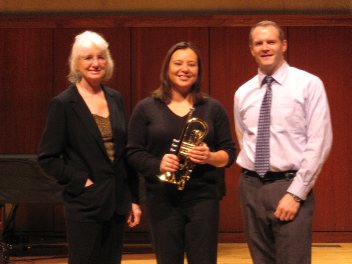
IWBC Pioneer Award Winners Carole Dawn Reinhart and Betty Scott

Opening Concert

The 10th anniversary of the International Women's Brass Conference kicked off in high style at the new Center for the Performing Arts at Illinois State University. The opening concert gala featured the Illinois State University Faculty Brass Quintet with Amy Gilreath, conference co-host, on first trumpet and Elisa Curren and Kelly Watkins, the current and former graduate assistants, splitting the second book. Before the quintet's dazzling display, Susan Slaughter, the founder of the IWBC, got the traditional first wrong note out of the way with a convincing "spleeah" on the opening of Pictures. Knowing Susan, I'm sure she practiced to make sure she would miss! Following this with a believable rendition of extremely poor intonation, she pointedly demonstrated that the pressure was off, setting the tone for a rewarding and inspiring atmosphere in which everyone would encourage and support one another.

On the heels of the opening remarks by James Major, the Mayor of Normal, Illinois, the director of the school of music at ISU (and husband to Amy Gilreath), and cohost Sharon Huff, the ISU Brass quintet took charge with J. S. Bach's My Spirit be Joyful. Following that was the world premiere of Impromptu and Toccata, a special IWBC commission for this gala event by Larysa Kuzmenko (composition faculty at the University of Toronto). This is a wonderful addition to the quintet repertoire featuring an initial slow winding theme spun out in low brass and then a variety of sections - some with dashes of scintillating muted brass writing. Out of one cascade of slow descending pyramids poured some beautifully sensitive chamber playing. This innovative work features idiomatic writing worthy of many performances. Brava to Ms. Kuzmenko, and kudos to the ISU BQ for a masterful premiere of the piece. The quintet concluded with Four Sketches by Anthony Plog - an exciting portrayal of Plog's rhythmically catchy style.

Next, the quintet was augmented by more brass for Karitas Habundat (antiphon) by Hildegard von Bingen, transcribed by Phil Snedecor, a trumpeter in the DC/Baltimore area. Separated only by a powerful bass drum blow, Cantiages de Santa Marcia by Alfonso X El Sabio was the second work, and featured placement around the large hall. The second piece revealed great piccolo trumpet playing by Amy Gilreath and Susan Slaughter - a relaxed, facile sound exhibited by both.

At this point, the IWBC Pioneer Committee honored two inspiring women, both of whom are trumpeters. The Pioneer Award is given to those women who have been trailblazers in their respective professional careers, have made major contributions, whose achievements have garnered high visibility, and who have demonstrated courage and perseverance over lengthy careers.

Betty Scott was honored for her 26-year career at the University of Missouri at Columbia for developing a class called The Creative Process and for her work in the alternate healing modalities.

The other honoree was trumpeter Carole Dawn Reinhart whose book Aspects of a Career has recently been published in a new edition. After studying at Juilliard and a stint in the Radio City Music Hall and American Symphony orchestras, and being featured on many television shows including the Tonight Show, she turned to Europe where her career blossomed and where she remains a professor at the prestigious University of Music (Universität für Musik und darstellende Kunst) in Vienna, Austria.

The evening continued with three pieces with guest hornist Freudis Wekre and friends. The moment for which the competitors of the solo competition had been waiting finally arrived. There were three categories of brass instrumentalists with prizes awarded for each individual instrument. Two of the three competition winners were trumpeters: Kelly Watkins in the 18 - 28 and Amy Nelson in the 28 and over.

The competition is open to men and women brass players and features playable music. The entire cost of this triennial competition, including prize money and accompanist fees comes from three years' worth of profits generated from the Holiday Brass Concerts in St. Louis, organized by Susan Slaughter. Much of the funding for the conference itself comes from this funding source, and all who experience the uplifting, supportive nature of the week were inspired to return to their respective communities and follow Susan's lead! (JS)

2000 Solo Competition Winners Recital

The conference began its first full day by reflecting back to the 2000 conference with the winners of that year's solo competition offering a winners' recital for the IWBC 2003 attendees. Beginning bright and early at 9:00 a.m., the recital featured 4 competition winners: 2 trumpeters, Todd Craven and James Ackley; Eric Bubacz, tuba; and Colin Williams, trombone. While the low brass provided a nice foil to the brilliant playing of the trumpeters, I'll highlight the upper brasses' accomplishments.

Todd Craven set the tone for the day immediately with his polished, flawless performance of the Honegger Intrada. He offered us a pristine quality to his attacks, exquisite intonation, and a beautiful, calm assurance in what is always a definite "mouthful" of a piece. Craven's control as he sailed from section to section was consistently wonderful and his production as smooth as silk. Todd Craven is a pearl of a player, ably demonstrating his easy, lyrical approach even when faced with a very demanding piece bursting with endurance-busting lines.

James Ackley chose two pieces to showcase his soaring lines and expressive vibrato: Turrin's Caprice and his own transcription of Vocalise by Rachmaninov. His pacing on the Turrin was well executed with sweeping lines in the lyrical sections, and a flashy approach for the alternating technical bits. He also revealed impeccable intonation and provided us an exciting finish to his opening piece. Ackley's transcription utilized the fat, thick nature of the flugelhorn's "money range." He chose a fairly direct rendering of the melody, refreshing in its simplicity. The transparency of his beautiful lines spun out on a golden thread of sound - a colorful treat for a familiar and sumptuous tune.

Bravo to both players for executing their respective repertoire at such an inspiringly high standard. (JS)

Lauraine Carpenter/Alice Gomez

Carpenter/Gomez Duo

The world premiere performance of Alice Gomez's Latin Jazz Suite for Trumpet and Conga Drums, performed by Lauraine Carpenter on trumpet and Alice Gomez on congas, was given on June 18, 2003. Carpenter, principal trumpet with the Toledo Symphony, professor of trumpet at the University of Toledo, and first trumpet of two brass quintets, commissioned this piece especially for this performance at IWBC, Illinois State University.

Carpenter and Gomez gave an engaging, entertaining and audience-pleasing performance of Latin Jazz Suite. This piece, in five movements, is approximately 12'30" and, as the title would suggest, is very rhythmic. Alice Gomez describes each movement: "Guaguanco is a challenging, intervallic Latin and swing combination. Bolero is like a slinky black cat lying on the window with motivic phrases played on different tonal levels and is reminiscent of a hot, humid night filled with reveries of the past. Mambo-cha is an accented, rhythmic but laid-back mambo. Afro-Cuban is performed with a Harmon mute, stem out and is to be done in a soulful 'Miles Davis with sunglasses' style. Cubop shows the influence of jazz into Cuba, with the technical, tonguing and rhythmic display of Desi meets Dizzy."

Alice Gomez has written over a dozen brass compositions, primarily low brass and quintets. She is the winner of many ASCAP awards, professor of music at San Antonio College and music director of St. Luke's Episcopal Middle School. Gomez was also Composer-in-Residence for the San Antonio Symphony from 1993-1996. Her music has been featured on several radio stations, as well as 20/20, and Public Television programs Heritage and ArtBeat.

Latin Jazz Suite, a highly recommended and fun piece, can be purchased from Creative Music Source, PO Box 700896, San Antonio, TX 78270-0896, USA. (BS)

Linda Brown

Linda Brown-trumpet/Karen Collier-piano

Linda Brown was one of three featured artists at the afternoon recital Thursday, June 19 (along with Shelly Showers, horn and Deanna Swoboda, tuba). Brown teaches at Mount Royal College in Calgary, Canada and has performed with the Calgary Philharmonic Orchestra for twenty years. She performed cornet on Rafael Méndez's version of La Virgin de la Macarena and her own creation, The Yellow Rose of Texas ... a Cornet Drama.

After the performance of La Virgin, props including a table, chair, and two trees were arranged on the stage. The Yellow Rose was then introduced and narrated by Sarah Reckmeyer. According to legend, The Yellow Rose was a beautiful girl who "distracted" Santa Anna, contributing to the Mexican loss at the Battle of San Jacinto, and eventually leading to the independence of Texas. Brown portrays The Yellow Rose in a clever melodramatic stage presentation, in which the cornet "speaks" the part of Santa Anna's lover. Brown showed her versatility combining music, acting and dance. Karen Collier did a great job accompanying at the piano and in portraying the character of Santa Anna.

Brown performed the two works on cornet with flair and a full, warm tone. Her tonguing was crisp and clear, appropriately styled for both the Méndez and the theme and variations of The Yellow Rose. (LB)

Marvin Stamm and Carolyn Sanders Master Class

At the IWBC conference, June 19, 2003, Marvin Stamm and Carolyn Sanders teamed up to give a masterclass entitled "Music and Fitness." Stamm, a well-known performer, clinician, and jazz educator, is on the Board of Directors and has been an active supporter of IWBC since its inception. Carolyn Sanders is on the faculty at the University of Alabama, Huntsville, performs with the Atlanta Baroque Orchestra, and is an active recitalist. In addition, Stamm is an avid runner/jogger and Sanders trains for triathlons.

Their master class was eagerly and warmly received. The presentation was split evenly between the two presenters, was accompanied by a useful three-page handout. The messages they shared include:

  1. Exercise is the best self-help thing we can do and it leads to a better quality of life.
  2. The benefits of exercise include increased self-confidence and energy, greater breath control (longer phrases) and over-all better practices and performances.
  3. Everyone can do some form of exercise. "Fitness has to be something you don't think about; you just do it." However, musicians already know how to do this because of our disciplined practice habits.
  4. Exercise, diet and controlled alcohol consumption can improve many aspects of
    musicianship, as well as life.
  5. 25% of the population is depressed. Exercise is very helpful in controlling depression.
  6. Small, consistent steps over time pay off in our practice as well as our exercise.
  7. Exercise allows for one's attention to be turned inward and allows the "self" to
    disconnect and separate from the frenetic world for the duration of our exercising.
  8. "Life is a series of habits." Find some form of exercise you can live with, make it a need in your daily life and find the motivation to do it consistently. (BS)

Sharon Jacobson-Stine on Natural Trumpet

Sharon Jacobson-Stine demonstrates on natural trumpet

Sharon Jacobson-Stine studied natural trumpet with Crispian Steele-Perkins and Edward H. Tarr, and has performed on natural trumpet with The City Musick, Basically Bach, Chicago Baroque, Lyra Consort, Ensemble Musical Offering, Apollo's Fire, and the Dayton Bach Society. For twelve years she has been an extra trumpet with Lyric Opera of Chicago.

Stine began with a demonstration of Clarke's Prince of Denmark on piccolo trumpet accompanied on piano and then again on the natural trumpet (with vents to correct out-of-tune partials) pitched in low D (A=415) and accompanied on the harpsichord. She then gave a thumbnail history of the instrument, playing an animal horn, hunting horn, hosepipe, and various sizes of post horns to demonstrate the pitch and timbre possibilities of each instrument. The importance of fanfares was discussed and Stine played several examples including the famous "Krakow" fanfare. Impure partials were demonstrated by playing the harmonic series along with the piano and by performing the Clarke/Shore Prince Eugene's March on a natural trumpet with no vent holes to correct impure partials. John Hyde's slide trumpet was introduced and Stine performed an Air from Handel's Se l'arco on a slide trumpet. She mentioned that with the right concept of sound, a modern piccolo trumpet and a natural trumpet could blend well. Charles Stine (on a piccolo trumpet) and Lisa Blackmore (on a natural trumpet with vents) performed an excerpt from Boyce's A Suite of Trumpet Voluntaries. David Maller performed the first movement of the Handel Suite in D on his own D trumpet without vents.

During the master class, a natural trumpet ensemble consisting of Stine, her husband Charles, Lisa Blackmore, and David Maller performed the Dorchester Fanfare and closed the formal section of the master class with an old French military fanfare L'entendard. Stine addressed questions from the audience and allowed all in attendance to come to the stage and try out instruments. Her pure tone and lyrical approach to the trumpet as well as her knowledge of the trumpet's history was appreciated. Gloria Cardoni provided excellent accompaniment for the recital on piano and harpsichord. (MB)

Marvin Stamm Combo

Marie Speziale joins Marvin Stamm

Thursday's evening concert featured Marvin Stamm and combo joined by Marie Speziale on flugelhorn and Audrey Morrison on trombone. Speziale and Stamm opened the concert with Deuces for the Misses written by Matt Holman, a student of Marie's. This multi-sectional modal piece featured Speziale's big, beautiful tone on flugelhorn and Stamm's smooth fluid solos. The duet followed this with a beautiful rendition of Here's that Rainy Day. The first half of the concert concluded with Audrey Morrison's performance of J.J. Johnson's Lament dedicated to Melba Liston and an original, Little Bird Blues, a down and dirty blues with plunger.

The second half of the concert was all Stamm and combo. What was most noticeable about the group's performance was Marvin's ability to play impossibly long phrases. It seems that he never breathes, adding a continuity to melodies and solos that was a pleasure to hear. He also solos inside the sound of the quartet so that less focus is on the melody and you hear the composition as a whole. There is clarity of pitch and consistency of tone in all ranges in his bebop solos that sets him apart. He saved his fieriest playing for flugel on his own composition Samba da' Nancy written for his wife. A final tune reunited Stamm, Speziale, and Morrison on Autumn Leaves. The rest of Stamm's trio included Kelly Sill on bass, Michael Kocour on piano, and Ed Soph on drums. (MB)

Athena Brass Band

Amy Nelson solos with the Athena Brass Band - please click photo for larger version

On Friday, June 20, 2003, the Athena Brass Band, in its maiden voyage concert, performed to an appreciative IWBC audience. Just two days before, this all-female group met and practiced for the first time. All the members of Athena were selected from bands in the North American Brass Band Association (NABBA). Athena's conductor, Anita Crocker-Hunt, is president of NABBA and Director of the Cincinnati Brass Band. The announcer, Keith Wilkinson, hails from the Cuyahoga Valley Brass Band.

The concert consisted of: Strike Up the Band (G. Gershwin), Cleopatra (E. Damare) [cornet solo], Journey Into Freedom (E. Ball), Over the Rainbow (H. Arlen) [tenor horn solo], Motivations (Anne McGinty) [commissioned by IWBC for the Athena Brass Band], Badinage (K. Norbury), Capriccio Espagnol (Rimsky-Korsakov), The Debutante(s) (H. L. Clarke) [euphonium duet], Irish Tune from County Derry (P. Grainger) and Celebration (L. Condon). At the end of the concert, there was a standing ovation. This was followed by an encore of Boogie Woogie Bugle Boy.

The cornet soloist, Amy Nelson ("Amazing Amy"), affiliated with the Chicago Brass Band, has been solo champion of NABBA in 1999, 2000, 2001, and 2003. Though the accompaniment was a little too loud and indecisive, Cleopatra afforded Nelson the opportunity to exhibit fast fingers and facile multiple tonguing.

Credit should be given to Bernal Music, Ltd. for donating much of the music used by Athena, as well as to Laura Lineberger (euphonium) who, as one member wrote me, "was the master mind for beginning the band and organized EVERYTHING down to the last chair and stand that went on stage before the concert."

This was an admirable performance, especially considering the small amount of time the group had to practice. It seems probable that Athena could become a stellar brass band if it continues giving concerts on a regular basis.

For those interested in learning about the brass brand tradition, check out www.nabba.org. (BS)

Army Blues Brass Section Master Class

Ingrid Jensen with the "Army Blues" rhythm section

This was a premier performance of sorts for the Army Blues, being the first outing for just the brass and rhythm section. Giant Steps kicked off this inaugural performance with Ingrid Jensen and MSG Craig Fraedrich as soloists. An arrangement of Shenandoah was included on the program. Makin' Whoopie, showcasing SFC Matt Niess' plunger work on trombone followed. The quote of the master class was made after their rendition of Here's that Rainy Day: "This group sounds fine without the saxes…please don't tell them."

Of course, at a brass conference highlighting women performers, special mention should be made of SSG Liesl Whitaker's great lead trumpet performance. Her accuracy was outstanding even at the breakneck speeds the Army Blues like to play. She has a distinctive, penetrating sound and showed no signs of tiring during the hour-long performance. During the brief question and answer segment of the master class, Whitaker said that the key to her endurance was just playing all the time and the Army Blues schedule readily accommodates that. The master class concluded with the jazz standard Time to Leave. (MB)

Joint Service Brass and Percussion Ensemble

United States Joint Military Band Ensemble - please click photo for larger version

This impressive collection of DC area brass and percussion players was formed at the 2000 conference. This year's group consists primarily of women from six premiere military service bands in the DC area.

These are the participating trumpeters and their corresponding groups:
SFC Ginger Turner - the US Army Field Band; SFC Sandra Quaschnick - US Army's Old Guard Fife and Drum Corp; Gunnery Sergeant Susan Rider and Staff Sergeant Jennifer Marotta - President's Own US Marine Band; Musician 1st Class Kelly Watkins - US Coast Guard Band; Musician 1st Class Ericka Schafer - US Navy Band; SFC Tammy Leverone - US Army Band - Pershing's Own.

The conductor for the evening was Major Beth Steele - Commandant, US Army Element Armed Forces School of Music, Norfolk, Virginia.

In true military tradition, the evening commenced with a powerful presentation of the national anthem. The large concert hall of ISU was utilized to capacity with all the trumpets on the left balcony facing the audience, the remainder of the group on the right balcony, and Major Steele positioned within the audience. Remaining in this position for Gabrieli's Canzone Duodecimi Toni, the massive ensemble demonstrated great finesse on their individual lines with good attention paid to intonation.

The concert continued with a brass quintet featuring Ginger Turner and Susan Rider on trumpets. Their first tune showcased Turner's transcription of Handel's Arrival of the Queen of Sheba from Solomon. This was a big piccolo piece for Ginger and had a lot of interplay between both trumpets. The next selection was Variations on America by Ives, arranged by Henry Howey. The quintet negotiated their way through some precarious trips and turns with ease. They concluded their foray from Baroque to the American scene with a further slice of Americana in It Ain't Necessarily So from the Porgy and Bess Suite by Gershwin. The group performed comfortably in a wide range of divergent styles.

The larger ensemble then gathered onstage, opening the final portion of the concert with Pima Fanfare, a noble piece by Jacquelyn Sellers. The Serenade for Brass by Robert Starer followed. This piece shared the workload equally among the six trumpets. The second movement featured a soaring solo, and the third movement, in contrast, was bombastic with "to-the-wall" brass playing. The Prelude by Rachmaninoff provided an interesting arrangement highlighted by Ginger Turner's brilliant piccolo playing. True to its name, the Haufrecht Symphony for Brass and Timpani allowed listeners the full range of the sonic spectrum. Jennifer Marotta consistently displayed a beautiful, singing sound on her solos. The third movement functioned as an appropriately impressive conclusion to a fulfilling concert-but there was more! The final tune, Berlin's God Bless America, brought out Liesl Whitaker from the US Army Blues who heated up the familiar melody, putting more than a bit of sizzle on it.

The audience was treated to a brass extravaganza spanning centuries and styles - one more reason for Americans to be proud of those serving in the US Armed Forces. (JS)

Monarch Brass

Monarch Brass - please click photo for larger version

The final concert of the conference featured the Monarch Brass, Heather Buchman, conductor. This group was formed in 1993 at the first International Women's Brass Conference and had their inaugural tour in 1996. The ensemble includes some of the best women soloists and orchestral brass players in North America and Europe. The trumpet section consisted of: Linda Brown (Calgary Philharmonic Orchestra); Lauraine Carpenter (Toledo Symphony); Amy K. Cherry (Brevard Chamber Orchestra); Amy Gilreath (Illinois State University); Theresa M. Hanebury (Houston Ballet Orchestra); Cathy Leach (University of Tennessee); Judith Saxton (Wichita Symphony); Marie Speziale (Rice University); and Kelly Watkins (US Coast Guard Band). The conductor Heather Buchman was principal trombone of the San Diego Symphony from 1988 to 2003 and now conducts the Hamilton College Orchestra and the Brass Ensemble.

After opening with the Sokol Fanfare from Janácek's Sinfonietta, Buchman described the theme of the program being "traditions of brass music". These traditions include fanfares originally written for brass instruments, a tradition of transcribing works originally written for other instruments, and commissioned works including the world premiere of Amy Williams' JB Montage.

Highlights of the program included the Sanctus by Marianne Ploger, a work in neo-Renaissance style originally composed for two choirs and double brass choir here presented for the first time arranged by the composer for triple brass choir. The JB Montage by Amy Williams was based on horn lines from the music of James Brown. The little "snippets" of tunes included fiendishly high trumpet parts ably performed by the four trumpet players. Eric Ewazen's Symphony in Brass was one of the most interesting works on the program. In three movements, the outer movements were lively and rhythmic with impressive technical playing. The middle Andante contained beautiful chorale-like sections; the ensemble was at its best in lyrical moments like this.

The overall impression of the ensemble was one of good solid playing throughout the group and a fluid approach to sound in each section. Heather Buchman's leadership was graceful and lyrical. Each member of the trumpet section was featured, and delicate piccolo playing (particularly in the Copland Simple Gifts from Appalachian Spring) all the way to lyrical flugelhorn solos (Grieg's Holberg Suite) were a joy. Mention should be made of the good acoustics of the new Center for the Performing Arts Concert Hall in making the listening experience even more enjoyable. Monarch Brass provided a stirring conclusion to a successful IWBC conference. (LB)

Websites:
International Women's Brass Conference
IWBC 2003 site
IWBC photos
School of Music, Illinois State University


Source: Lisa Blackmore, Mark Blackmore, Judith Saxton and Betty Scott
© Copyright 2003 - International Trumpet Guild™ - All Rights Reserved