Conference Coverage HomeConference InformationConference Schedule of EventsArtist ListArtist BiographiesConference Registration [pdf]

Friday, May 23 – 9:30am
Ed Landreth Auditorium
TRUMPET CLINIC & DEMONSTRATION
presented by
David R. Hickman
Regents’ Professor of Trumpet
Arizona State University
and the
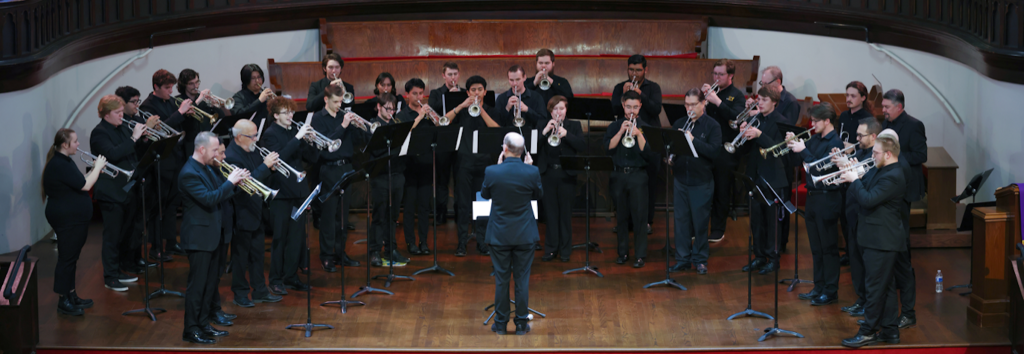
Arizona State University Trumpet Ensemble

Michael Arndt - DMA (ABD), Murfreesboro, Tennessee
Jean-Christophe Dobrzelewski - DMA/Teaching Assistant, Neuchatel, Switzerland
Erik Hasselquist - BM (Sophomore), Stillwater, Minnesota
Andrew Kissling - BM (Junior), Robesonia, Pennsylvania
John Marchiando - DMA/Teaching Assistant, La Crosse, Wisconsin
Dustin Maroney - BM (Sophomore), Chandler, Arizona
David Melancon - BM (Sophomore), Baton Rouge, Louisiana
Jason Mosall - MM (first year), Middleburgh, New York
Amanda Pepping - BM (Senior), Albuquerque, New Mexico
Brian Shook - MM (second year), Mansfield, Ohio
Jennifer Stirling – BME (Freshman), Mesa, Arizona
Kristin Stoneback - BM (Junior), Sioux Falls, South Dakota
Mary Stoneback - BM (Junior), Sioux Falls, South Dakota
Sarah Stoneback - BM (Junior), Sioux Falls, South Dakota
Allyn Swanson - BM (Senior), Bowie, Maryland
Assisted by
Gail Novak, Piano


Judith Saxton, reporter

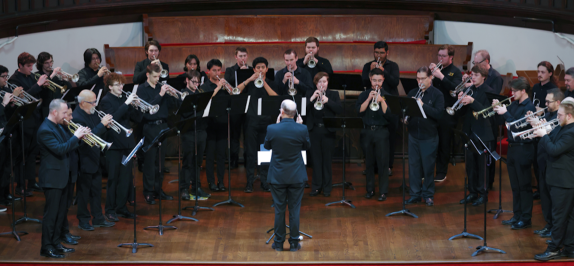
The David Hickman master class was the only event occurring at 9:30 a.m. on Friday, and the auditorium was filled with those keen to hear about the pedagogy that Hickman has developed as professor of trumpet at Arizona State University in Tempe, AZ and before that, at the University of Illinois-Urbana/Champaign. It’s always reassuring to learn pedagogy that has been tried and tested by a performer with over 2,000 solo concerts in a thirty-year career! Hickman admitted that at this point he relishes sitting in a studio with a student far more than the inside of another airplane! The concert opened with a sonic blast from the fifteen-member ASU Trumpet Ensemble. Hickman then outlined the typical trumpet student contact hours at ASU: one-hour private lesson, one-hour group lesson which usually focuses on orchestral excerpts, one-hour pedagogy class where they study the full range of method books, and a two-hour repertoire class where they listen, and study scores and composers. The professor then utilized his amazing trumpet studio to aptly illustrate his teaching ideas, grouping them in a variety of combinations.

The first topic deemed the most fundamental by Hickman was embouchure development. Without a well-formed embouchure, good tone just doesn’t happen. He mentioned that the mouthpiece must be centered vertically and horizontally, with vertically being the more crucial of the two. The top lip is the one that vibrates, so the rim-edge cannot be in the red or else it would prohibit the necessary vibrations. Jaw alignment is often overlooked: it is necessary to avoid being too severe with either an under or overbite. The mouthpiece should be pressed 60% bottom and 40% top. The lower lip should take the majority of the beating.

Following these opening remarks, Hickman got into the four “P’s.” Pucker – utilizing the musculature of the face to form the embouchure.

Push – having the necessary wind support
Pressure – the amount of mouthpiece pressure required by the music.
Placement – positioning the mouthpiece.

The important thing to strive for is a constant balance between these four factors. Doing lip bends and pedal tones on the B-flat trumpet are the exercises that promote this balance. Lip bends should be started from the comfortable middle register, and in time can be continued into the pedal range. As you descend, insure that the lower lip puckers (engages) more for it will vibrate more the lower you go. Pedal tones should be limited in practice time since they promote the dropping of the back of the tongue. Do not go “down and away” with the horn, and maintain your four “P’s” as you descend. Lip bends can be done from 1/2 step – 1 1/2 steps, always bending down loud and slow with the middle note being just as strong as the outer notes, thereby finding the “sweet spot.” David mentioned his Trumpet Lessons with David Hickman, especially volumes 1, 2 and 3 as a resource for his lip bend exercises.

David Hickman recommends that every student own four mouthpieces with the same rim and various cup depths, and Hickman, himself prefers a funnel-shaped mouthpiece.

J.C. Dobrzelewski demonstrated tonal colors beautifully on Hickman’s B-flat German posthorn. The posthorn solo from Mahler’s Third Symphony sounded very round, dark, full, and mellow, with just a bit of sweet edge. This was a personal highlight – to hear the instrument for which Mahler originally conceived the solo. The Mahler Third Symphony finale was then executed with great control by four trumpeters. Next, the principal of that section, John Marchiando, switched hats and performed “Incantation” from Two Portraits, showing beautiful control on the final note.

On articulation Hickman spoke of alternating flutter tonguing and single tonguing to clarify proper tongue position. If one can’t flutter tongue, place the pinky halfway into the mouth and say “dah” - that creates a similar effect. He demonstrated “pop” tones – a very quick tongue stroke creating a short sound: this targets the middle of the note dead center. I thought it sounds like an elf tiptoeing around, gossamer and fleeting. A quick tongue is necessary for any clear articulation. Hickman does not differentiate between single and double tonguing, preferring instead to multiple tongue: tuku tuku, but shifting the accents to accommodate the necessary duple or triple structure. By always placing tuku next to each other, one can increase their tonguing speed by 50%. Amanda Pepping, a senior at ASU, then played the Rafael Méndez arrangement of Csardas with fitting flair and panache. As the session continued, piccolo was demonstrated by three sophomores playing excerpts from Bach’s B minor mass. A sympathetic crowd applauded as the principal, David Melancon, nailed the high G in the Credo on the second try.

In answer to a number of questions regarding practicing, Hickman mentioned spending 80% of your practice time on only the problem spots of the etude, design flashcards to focus in on those spots, practice what you cannot do. For performance majors, practice two to three hours daily, limit oneself to two ensembles, if possible, and have the horn on your face five to six hours per day tops.

This session was incredibly informative, packed with proven methods of seasoned pedagogy aptly illustrated by his current trumpet studio. As Hickman stated, “Above all, find what works for you.” With this session, all of us left better equipped to excel the next time we practice and perform.

The conclusion was a spectacular arrangement of Concert Etude by Goedicke that Hickman arranged, including every sixteenth-note run from the piano part! Thanks to professor Hickman for an exciting conclusion to a wonderful morning of information.

Trumpet Prelude:
Southeastern Louisiana University Trumpet Ensemble
Director: Dr. Bryan DePoy

Three Statements by Kevin Houben

1. Don't hold back
2. Be relaxed
3. Don't waste your time

Fanfare for the Protean Age (2003) by Stephen Suber **premiere performance

Members:
Justin Albritton, Charles Arnold, David Delaney,
Kevin Messer, James Riley, Nick Volz, Demarr Woods


Program:

I. Opening Performance: Inaugural Fanfare (2002) by Randall Shinn

II. Opening Remarks: David Hickman

III. Pedagogical Topic No. 1 - “Embouchure Development” (the 4 “Ps”)

Musical Demonstration: Cocktail (in 3 movements) by Jerome Naulais
Andrew Kissling, Jason Mosall, Allyn Swanson, Dustin Maroney, Brian Shook

IV. Pedagogical Topic No. 2 - “Tonal Colors” (“Targeting”)

Musical Demonstration: Symphony No. 3 (“Posthorn”) by Gustav Mahler
Jean-Christophe Dobrzelewski, soloist

Movement VI (excerpts)
John Marchiando, J. C. Dobrzelewski, Amanda Pepping, Erik Hasselquist

V. Solo Performance: Incantation from “Two Portraits” by Joseph Turrin
John Marchiando, Trumpet Gail Novak, Piano

VI. Pedagogical Topic No. 3 - “Articulation”

Musical Demonstration: Sensemaya (excerpts) by Silvestre Revueltas
Suite I: Daphnis et Chloe (excerpts) by Maurice Ravel
Sarah Stoneback, Kristin Stoneback, Mary Stoneback, Jason Mosall

VII. Solo Performance: Czardas by Monti (arr. R. Mendez)
Amanda Pepping, Trumpet Gail Novak, Piano

VIII. Pedagogical Topic No. 4 - “Piccolo Trumpet “ (“Falsetto”)

Musical Demonstration: B Minor Mass (excerpts) by J. S. Bach
David Melancon, Dustin Maroney, Erik Hasselquist

IX Questions & Answers

X. Finale Performances:
La Virgen de la Macarena by Montrede arr. Mendez/Hickman
David Hickman, Soloist

Concert Etude (for 12 trumpets) by Alexander Goedicke - trans. by David Hickman

© Copyright 2003 - International Trumpet Guild™ - all rights reserved