ITG Home Page News from the Trumpet World ITG Journal ITG Calendar of Events Employment Opportunities Around the World ITG Links of Brass Related Web Sites Join ITG Online Search the ITG Web Site

Wednesday 3rd July – 15.30
Brown Shipley Concert Hall
Celebrity Master Class

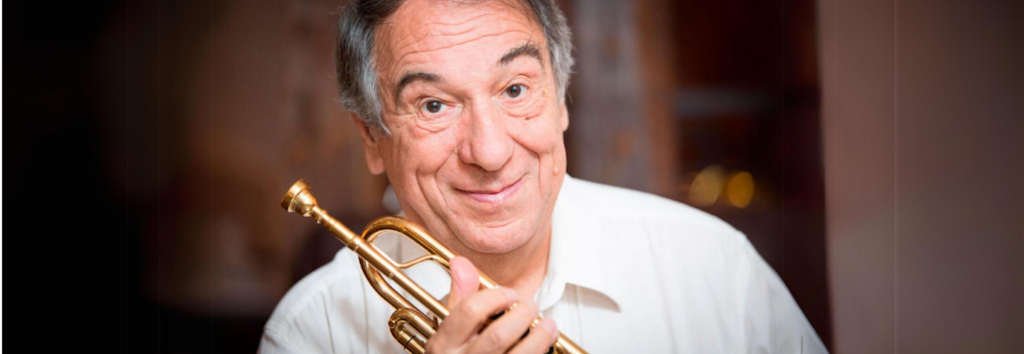
Häkan Hardenberger

Håkan Hardenberger arrived in the hall to a warm reception from a large and enthusiastic audience. He didn't disappoint: we enjoyed a most illuminating afternoon, of benefit to the students and audience alike.

The first student to play was Chris Heldt, with the Goedicke Concert Etude. Hardenberger gave him a most thorough session on this piece, concentrating largely on getting relaxed enough to produce a really fine tone, and on being relaxed enough too, paradoxical though it sounds, to do really precise and fast slurs. He reminded Heldt, and us, that no matter what speed the music is, the slur itself is always fast - more or less instantaneous: "The change between the notes is always very quick, even if the music is slow – unless it says portamento or glissando!"

Still on slurs, Hardenberger spent a long time demonstrating his view of the need to think up while the slur goes down and vice versa. This can be echoed in, for example, a left arm movement which reminds us of the directional thinking, and helps to focus all the physical movements that need to be co-ordinated into the one moment of the actual slur. A full description of this portion of the master class would take up many pages but suffice it to say that he ended up with a rather wonderful moment where, having talked and pummelled Heldt into a pretty convincingly relaxed state, he was more or less "playing" Heldt by raising and lowering his arm as the slurs went down and up. A most convincing demonstration. I was also taken with another of Hardenberger's comments on Heldt's performance - "I believe you are a very nice person, but you don't need to prove it in this piece!" - while asking for more aggression in the fast section.

We also heard some useful general comments on the problems of playing trumpet and piano music. Hardenberger feels that the relationship between the two is problematic, and that the contrasting sound of the piano makes the player feel naked and unsure of what dynamic to use. In an effort to get the maximum sound and energy from the piano, and to improve communication between the performers, he opened the lid and moved the soloist's position to the far end to insure good eye contact and so that the trumpet player can hear the piano clearly.

The next student to play was Tom Osborne, with the Albinoni Concerto in Bb (originally an oboe concerto) played on his beautiful Scherzer rotary valve piccolo. Hardenberger worked a lot on relaxing so as to let the music through the technique: he was looking at ways of minimizing the effort - for example, playing a stream of high notes as if they were all part of the same long breath, all in one flow, rather than as a series of separate notes. Keeping a feeling of freedom and relaxation on the high notes also helps to avoid problems with intonation, he added. His whole approach was to work with the instrument: "Never fight a trumpet, because it will always win ... you have to make it your friend." On breath support, Hardenberger warned Osborne and us against getting all the support knotted up too high in the body, which he feels leads to tension and a strangling of the tone. The support must be moved lower - about one inch below the navel is the crucial point, the strongest point, he tells us, in the body.

I was very taken with Hardenberger's enthusiasm and physical engagement with the music during this master class. He sometimes almost dances round the student, half-conducting, almost making the performance flow by his physical interaction with it. It's a striking thing to witness and must affect the students when they see the extent to which he is involved with the music. Hardenberger is committed to helping the students to play better - this is not a master class you would come to if you wanted to see students being undermined and having their morale sapped. Speaking to them afterwards I was most conscious of just how much they had enjoyed it - though it looked to this reporter like a pretty awe-inspiring experience - and how much they seemed to have gained from it.

The final student was Goni Eshed who brought the very challenging Sonata by Antheil. Hardenberger regaled Eshed and us with tales of Antheil's rather extraordinary life and works - this Sonata, though it seems pretty extreme at times, was apparently written at a time when Antheil was returning to a more conventional approach, which certainly left me wanting to know what he sounded like before that! Antheil was also the co-holder of a patent, with the Hollywood actress Hedy Lamarr, of a very advanced torpedo guidance system. Not many people know that, as Michael Caine would say - you learn some great stuff at these master classes! The torpedo business was perhaps not as far "off-topic" as you might think, for what Hardenberger was emphasising was the mechanistic nature of the music and Antheil's interest in electrical and mechanical forms of expression. "More Shostakovich!" was the cry during one of these spiky passages. Another area for study in this part of the master class was getting the long phrases connected, thinking through them, and producing lots of sound all the way through, as well as looking for changes in dynamic and articulation to point up the contrasts.

Everyone seemed to have got something different and positive from this master class. One of the students had always wanted a lesson with Hardenberger. His expectations were met, and indeed exceeded; another went home with much to think about in his approach to the music and his understanding of its composer; a third has a new perspective on slurs and on freeing up your approach. I went away from it impressed by the young performers (and I must add by their stalwart and extremely reliable accompanist), and bowled over by Hardenberger's wonderful teaching, caring approach, and superb communication with the students and audience. (Neville Young)

Trumpet Prelude
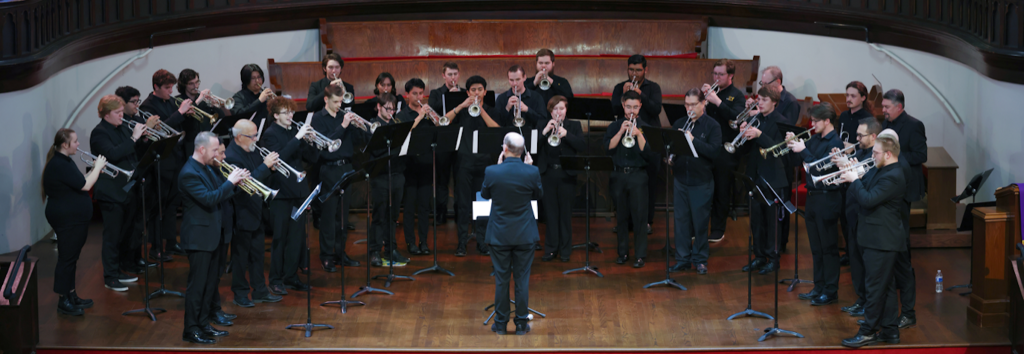
Ithaca Trumpet Crew
director Jane Dunnick
Adrienne Clermont, Andrew Dawson, Rebecca Graham
Abigail Hinchcliff, Danielle Koplinka-Loehr
Peter Speh, Michael Tilton

Samuel Ward arr. Dana Wilson - America
Danielle B. Koplinka-Loehr - Fantissimo
Traditional arr. Stephen Hatfield - Las Amarillis