ITG Home Page News from the Trumpet World ITG Journal ITG Calendar of Events Employment Opportunities Around the World ITG Links of Brass Related Web Sites Join ITG Online Search the ITG Web Site

Saturday 6th July – 13.30
Brown Shipley Concert Hall
Festival of Trumpets Concert

Click here for the Festival of Trumpets Photo Gallery!

Karl Sievers and Neville Young, Reporters
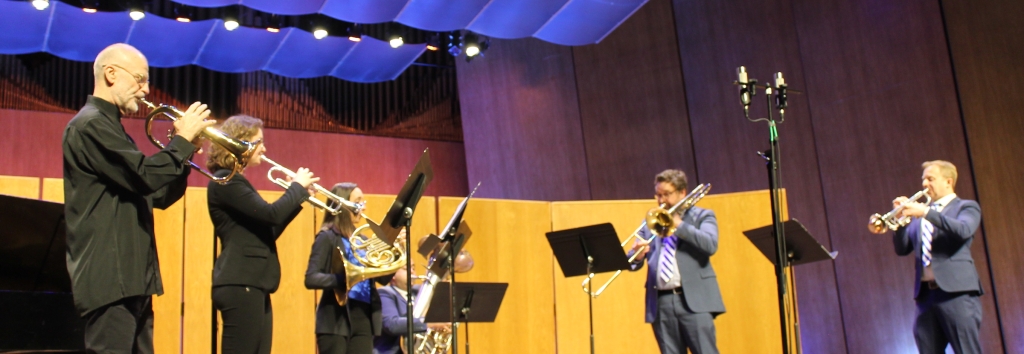
The Brown Shipley Concert Hall at the Royal Northern Conservatory of Music was the site for the Festival of Trumpets concert on the final day of the 2002 ITG International Conference in Manchester, England. As many of you know, this concert serves to give a performance venue for professional trumpet artists, most of whom otherwise are not featured performers at the conference. Styles of music presented range from traditional to jazz to avant-garde. I think it is accurate to say that all of the pieces came off terrifically; this being perhaps the strongest Festival of Trumpet concerts in recent memory. Bryan Goff of Florida State University was this year’s organizer, and he did a super job not only of selecting tunes, but of matching players to roles. Certainly, successful concerts of this type rely on the savvy of the organizer, so kudos to Bryan for a job well done.

Jim Olcott met early every morning, conducting reading sessions, to allow the opportunity for delegates attending the concert who were not included in the week’s performance roster to enjoy music making with new friends. This group therefore presented the prelude music for the concert, and they sounded super. Congratulations to all of them, and for their very professional contribution to the music of the week. This is the true spirit of ITG music making and is so important at these conferences.

The program opened with the very traditional Fanfare from La Peri by Paul Dukas. Frank Campos conducted this performance, scored for 4 trumpets and 3 flugelhorns. This opening work was played with energy and brilliance, setting the tone for the concert that was to follow. Richard Cox conducted the next piece, which was the André Campra Rigaoudon, scored for two choirs, each consisting of Bb or C trumpets and piccolo trumpets. Phil Norris next conducted Con Lenezza by Jack Kimmell. This is a smaller, more sensitive work, scored here for four trumpets.

The first real change of direction came with the next work, Terry Everson’s arrangement of There’s a Great Day Coming. This work was presented in a gospel/jazz style, with each performer having a solo section, and ending with Ramon Vasquez pegging a double Bb on the end that I expect was heard in Piccadilly.

Peter Lawrence’s composition, Matterhorn, was set in a Latin-jazz style, and had the added flavor of Iain Muirehead’s sound on the low F alto trumpet. This arrangement mixed the timbres of trumpets, piccolo trumpets, flugelhorns, and harmon mutes. This piece begins very quietly, moves into the main, up-tempo section, with solos passed through the group, and ending very quietly, as it began.

The Festival of Trumpets continued with Byrd’s Ave Verum. Having just been at Dave Staff’s lecture on performance practice I was particularly alert to the intense, vocal quality of the legato playing. It was wonderful to have the individual lines weaving into this wonderful texture and then the great blocks of sound moving across the stage in antiphonal groupings. If you closed your eyes, it was instant cathedral.

Seventh on the programme came Ellenberger’s Fanfare for a New Day which alternates a more conventional fanfare style with sections of a dancelike nature. These have complex rhythmic counterpoint picked out in the lower parts and provide an effective foil to the fanfare sections. After a couple of alternations, the fanfare idea returns and the piece concludes in that mood. This is a novel and interesting piece which received a fine, precise performance.

I often think that we take low trumpet playing for granted. We all know high playing is “hard” and we really appreciate players who do it well, which is right and proper. But time and again during this concert I was struck by just what a great job was being done on those 6th or 7th or 8th parts which are the foundation of these things. In this sort of arranging they are often really very low, because in the absence of other instruments the trumpet really needs to use its whole range to get some harmonic and tonal freedom. In a lesser gathering this might mean that these low parts are given to less able players but that so clearly wasn’t the case here and it was a real joy to hear all those low Gs and F#s being pumped out with precise placing and a full tone.

Gill Cline’s Corniche is a complex work for eight trumpets which mixes a rich harmonic language with exciting angular melodic lines as well as some longer, more spacious melodies. In the middle section is a wonderful effect where the players do a tremolo (alternate fingerings) on long notes and then rotate on the spot while continuing this: it makes for a most unusual and intriguing sound. Increasingly assertive interjections lead back to an impressive ending.

Variations in a Flamenco Style gave us some real Morricone moments, starting with wonderful Spanish-style trumpet calls over a slow backing. There are some more, shorter, solos – one or two very high – and fast variations with the lead passed rapidly between parts. Another slow solo section, played with impressive feeling by this quartet, takes us back to a fast ending with the note known in my household only as “Top Z” ringing out high and clear.

The tenth piece, Fanfare for Columbus, is another work for eight-piece ensemble. It begins with a fanfare with antiphonal upwards showers of triplets and moves into the main part of the work with long phrases and perhaps a feeling of foreboding. This melody continues with semiquaver interjections until it builds to another fanfare with more climbing arpeggios.

Donald Wilson wrote Canonic Variations on Amazing Grace in response to the events of September 11.. Performed by ten trumpeters, it was balm to the ears after the excitement of some of the previous works, a calm, contemplative piece which through the canonic use of the melody sets up a simple diatonic harmony, moving gently through its own sound-world. Here there was no excitement, no big moments, just beauty of tone. The Moser Scherzo which followed, played by ten trumpets and a bass trumpet, was brisk and angular, with some tricky and exposed moments which were handled well by the group. A piece with dramatic changes throughout, it ends with some Janacek-like moments following a period of deliberately chaotic yet controlled frenzy.

Piccolo trumpet fans and Beatles enthusiasts alike both received a treat with Penny Lane, arranged by Roger Harvey, and performed by a large ensemble of two piccolos, seven trumpets, two flugels, bass trumpet, cimbasso and drums. It had a great overall feel, the “traditional” piccolo parts (originally performed by David Mason) were carried off with verve. As a bonus, there was additional piccolo trumpet writing beyond the old material, which added a exciting new flavour.

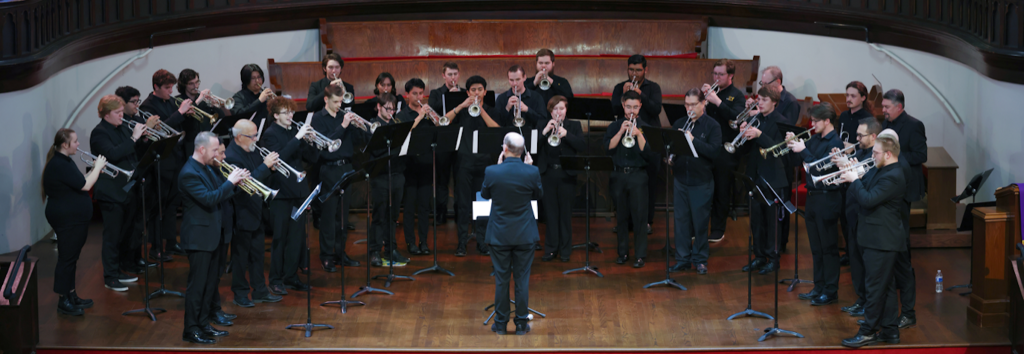
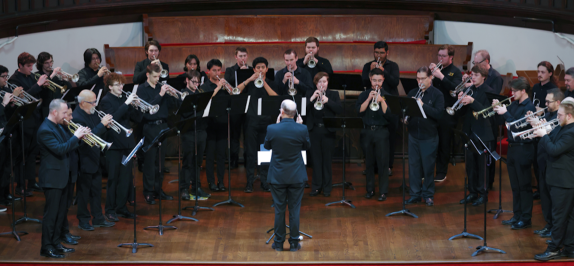
The last item was a monster arrangement of parts of Handel’s Royal Fireworks Music, performed by over forty musicians including timpani, cimbasso, euphonium, bass trumpet, and a whole battery of flugelhorns. It was a stunning sound and has possibly caused structural damage to the theatre: I’m sure I saw some cracks appearing in the brickwork. The audience left this event – which felt like an intriguing cross between a conventional concert and a rather large family reunion – with the grand sounds of Handel ringing in their ears.

Programme

EWAZEN - Concert Fanfare
DUKAS, Paul arr. Marie Speziale – Fanfare from ‘La Peri’
CAMPRA, André – Rigaudon
KIMMELL, Jack – Con Lenezza
EVERSON, Terry – There’s a Great Day Coming
LAWRENCE, Peter – Matterhorn
BYRD, William – Ave Verum
ELLENBERGER, Kurt– Fanfare for a New Day
CLINE, Gill – Corniche
VASILEVSKY – Variations in a Flamenco Style
RITTER GEORGE, Thom– Fanfare for Columbus (Fanfare No. 5)
WILSON, Donald – Canonic Variations on Amazing Grace
MOSER, Franz – Scherzo
LENNON / McCARTNEY arr. Harvey – Penny Lane
HANDEL, G.F. arr. Simon Wright – Music for the Royal Fireworks